
Rental: Real-Time De-Feedback Processing Rack
We’ve recently added a dedicated De-Feedback processing rack to our production inventory. Designed for difficult live audio environments, this system can now be deployed as part of larger event packages when additional gain-before-feedback and speech intelligibility are needed.
Built around Alpha Lab Studio De-Feedback, this rack is intended for situations where traditional system tuning and EQ can only go so far — reverberant rooms, difficult microphone placement, wireless presenters moving too close to loudspeakers, and other challenging live environments.
In early deployments, we’ve already seen situations where microphone channels could be pushed 20db farther in difficult rooms while also noticeably improving speech clarity in livestream mixes. We’ll touch more on some of those real-world results later in the post.
A Dedicated, Deployable, Real-Time De-Feedback System
Rather than running De-Feedback on a general-purpose laptop, this system was built as a dedicated deployable rack designed specifically for live event use.
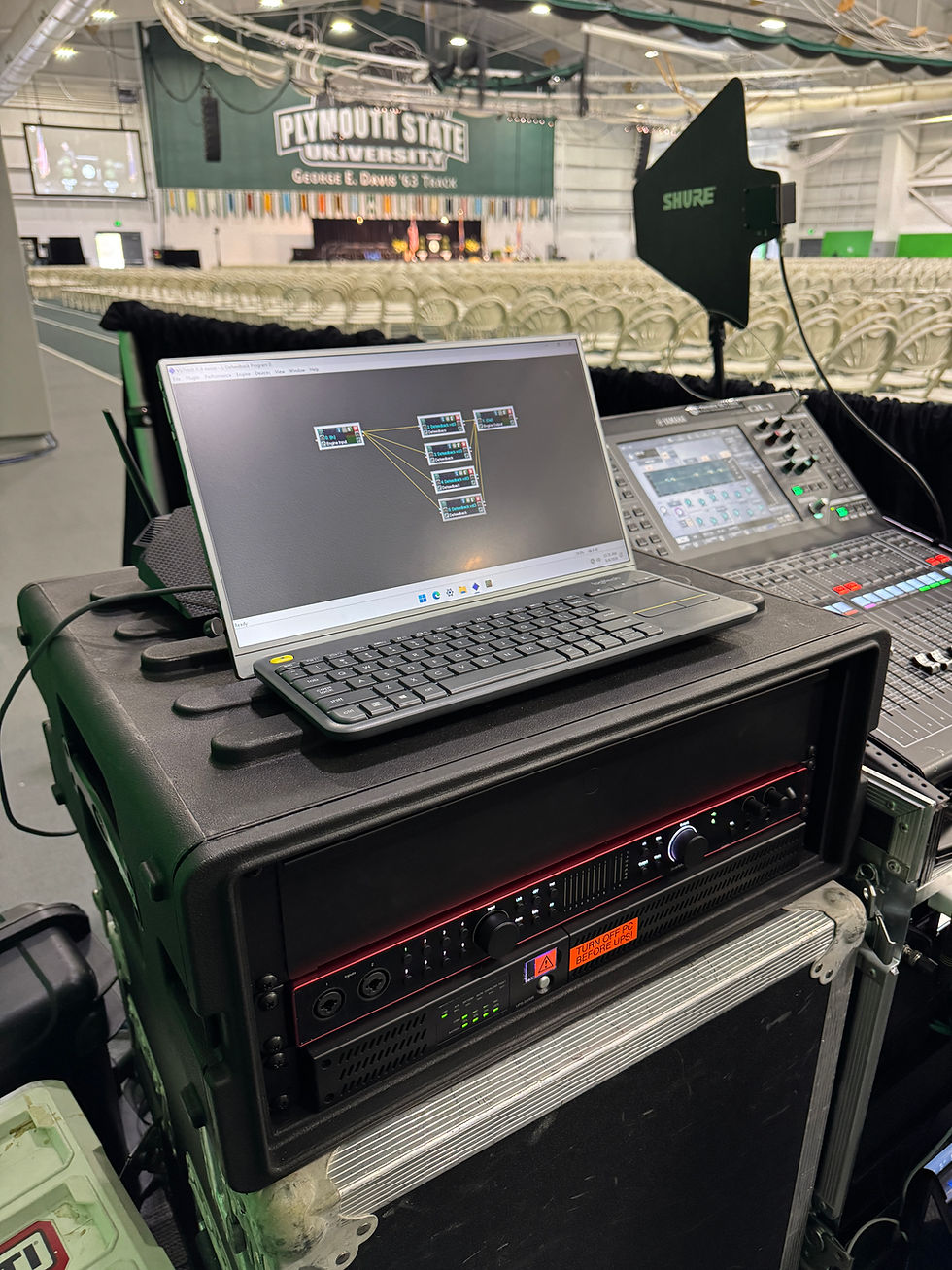
The system is housed in a 4U SKB roto-molded rack case and includes:
Dedicated processing computer
Focusrite Scarlett 18i20 4th Gen audio interface
Middle Atlantic UPS
Arzopa Z3FC monitor
The rack also includes:
4-in / 4-out XLR patch panel
PowerCON input
Keyboard and trackpad
Dedicated system power controls
Everything needed to deploy the unit travels together in a single self-contained package.
Designed for Difficult Rooms
This system is primarily intended for live speech reinforcement in spaces where feedback can become difficult to manage.
Potential applications include:
Reverberant rooms
Corporate presentations
Panel discussions
Live choir performance
Areas with less than ideal microphone placement
The De-Feedback software performs real-time analysis and processing across up to four channels, helping improve usable gain before feedback while maintaining natural speech intelligibility.
This isn’t a replacement for proper loudspeaker deployment, tuning, or microphone technique — it’s another tool in the toolbox for especially challenging environments.
Built for Live Production Workflows

The rack was designed to integrate cleanly into existing production systems.
Audio can be patched directly through the rear XLR panel, allowing the processor to be inserted where needed in the signal chain without major workflow changes. The integrated UPS and dedicated hardware platform also help keep the system stable and predictable during live operation.
Early Real-World Results
While we’re still continuing to experiment with workflows and deployment methods, the system has already proven useful in several live environments.
At Plymouth State University graduation ceremonies, we were able to achieve roughly 20 dB more usable gain within the signal chain on choir and podium microphones while also significantly reducing the hollow, reverberant character of the room in the livestream mix. In fact, the processed audio became clean enough that we intentionally opened an additional ambient microphone to add some natural room sound back into the outgoing livestream mix.

During recurring productions at SNHU Arena, the system has also been used on announcer and commentator microphones in situations where loudspeaker placement near the center of the arena floor creates especially challenging feedback conditions.
At a recent North Andover Town Meeting, we were able to push microphone levels significantly farther than usual using the standard event package we normally deploy, all while staying comfortably away from the edge of feedback.
One of the biggest practical differences so far has simply been confidence. Instead of constantly asking “How much more level can we safely get out of this?” That concern largely disappears, allowing us to focus more on intelligibility and overall mix quality.
Another Tool in the Toolbox
This system is something we can now include as part of larger event packages when additional speech clarity and feedback management are needed.
Like many production tools, it works best when combined with proper system design and engineering — but in difficult acoustic environments, it can provide another layer of flexibility that helps keep events running smoothly.


Comments